
Buying “GLP-1-Friendly” Convenience Foods is Not the Solution
If taking a GLP-1 drug for weight loss, all meals should be centered around healthy proteins and fiber, which do not come from convenience foods, but from foods prepared at home.
Are you on one of the many forms of GLP-1 drugs in an effort to lose weight?
For many people, GLP‑1 medications feel like a lifeline -- especially after years of dieting, shame, and metabolic confusion. Convenience foods marketed as ‘GLP‑1 friendly’ promise to make this process easier. Unfortunately, ease and health are not the same thing.
Food marketers have been quick to see that offering food products with a “GLP1-friendly” label means more sales – and more profits.
And guess what? “GLP-1 friendly” is not a regulated label, so food brands can use it in any way they choose, and I will be sharing one example in this article.
From a science perspective, here’s what makes a food or a meal GLP1-friendly. It’s nutrient-dense, high in protein and fiber, low in sugar and unhealthy fats. That’s it.
People on these drugs need these types of food to help offset the typical muscle loss and other adverse effects, such as diarrhea and constipation, while the protein and fiber are meant to further help suppress appetite.
The goal of this article is to demonstrate two things. First, that you can easily make much healthier GLP-1-friendly options at home. Second, that you stop believing the labels on the front of ultra-processed foods and start paying much closer attention to the ingredients list.
The focus here is on empowering you to take back your health while utilizing a GLP-1 medication – and that means focusing on consuming the highest quality foods you can afford – and making the investment to cook rather than simply reheat.
A Healthy Meal Compared to an Ultraprocessed Food Meal
Let’s compare two different meatloaf meals: one from a common and popular ultra-processed food brand and the other a meatloaf meal cooked at home.
Option 1: Frozen "Convenience" Meatloaf Meal
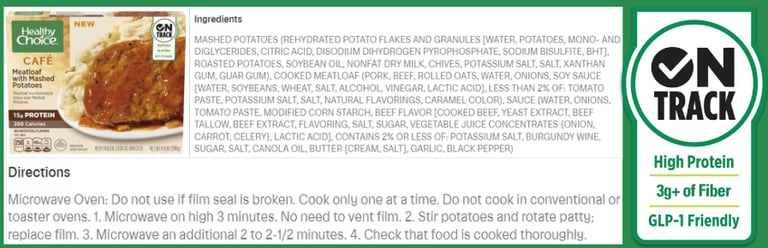
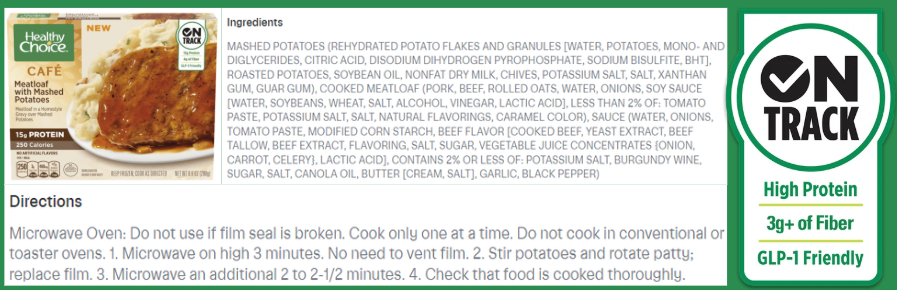
Let’s choose a brand that even claims healthy in its name: Healthy Choice. The company has a line of “café” products that they claim are GLP-1-friendly. Some of these same meals are produced in a non-GLP-1-friendly style. The difference between the two meatloaf products is that the “friendly” meal does not include corn, but it still contains the same meatloaf and mashed white potatoes.
Let’s start with the ingredients list. (See the list above.) What do you see? First, I see mashed potatoes are the top ingredient, which is opposite to nutritional advice; the meatloaf should be the top ingredient. Second, I see a host of red flags that do not say healthy… starting with all conventional and cheap ingredients, many of which are chemical additives – disodium dihydrogen pyrophosphate or butylated hydroxytoluene, anyone? The product also includes two seed oils (soybean and canola), modified corn starch, rolled oats, and sugar. I also don’t like that the meatloaf is a combination of conventionally-raised pork and beef, with more pork than beef.
The mashed potatoes seem an odd choice, especially when processed and paired with refined ingredients, because white potatoes are high on the glycemic index (GI), with most varieties ranking between 70 and 85 on the GI scale, where 100 is pure glucose. The potatoes are also a bad choice – not a healthy one – because conventionally grown potatoes contain high amounts of pesticide residue, currently on the “Dirty Dozen” list published by the Environmental Working Group (EWG).
Next, let’s turn to the item and its heating directions. Please note that the food products are placed in a plastic tub with a plastic seal covering it – and the directions call for heating it up in the microwave for 3 minutes. Plastic and microwaves do not work well together, and people should not be using plastic in the microwave because of chemical leaching from the plastic.
Convenient? Sure, because it heats up in 3 minutes, right? This is the problem we face with our food supply. Food marketers are making ultra-processed food products convenient, but not necessarily healthy or safe.
Option 2: Home-Cooked Mini-Meatloaf Meal
Here’s my recipe for a much healthier but a bit less convenient meatloaf meal, made with grassfed beef (though you could substitute ground chicken, turkey, or wild game) and organic broccoli florets. (You can also find the recipe here.)
Many people on GLP‑1 medications find they naturally eat smaller portions, so a plate of one mini loaf with vegetables is often more than enough.
Why this meal works: high‑quality protein supports lean mass, vegetables aid digestion, and minimal processing reduces nausea and rebound cravings.
Takes about 40 minutes to prep and cook.
Makes 6 servings (of about 4 mini loaves).
Ingredients
2 pounds of ground pastured beef
1/2 cup of chopped carrots
3 pastured, organic eggs
1 1/2 cups of finely chopped organic mushrooms
1 medium onion, finely chopped
1/4 cup of chopped onion
1 garlic clove, minced
2 tablespoons organic tomato paste
1 tablespoon of organic mustard
1-2 teaspoons of Italian seasoning (to taste)
Salt and pepper to taste
Directions
Preheat oven to 375 degrees.
Prepare a baking sheet with parchment paper.
In a large bowl, mix together all ingredients.
Separate the mixture into four equal parts and form the loaves on a baking sheet.
Place in oven for 30 minutes.
Remove from oven and serve.
Consider drizzling with organic sour cream, Kefir sour cream, Ranch dressing, a simple tomato sauce, or a sugar-free ketchup.
When the meatloaf is nearly done cooking, steam some fresh or frozen organic broccoli.
There are numerous variations you can make to the recipe, but notice the simple ingredients, with no added sugars, seed oils, bread/oats/flour, or questionable chemical additives.
Final Thoughts on GLP-1-Friendly Foods
Support your weight loss in the best and healthiest way possible by buying and preparing the healthiest ingredients possible; please do NOT fall for these marketing gimmicks.
Food quality is always essential, but perhaps even more so for people taking these GLP-1 drugs, because it still determines muscle mass, micronutrient sufficiency, gut health, and long‑term health outcomes.
Please remember that ultra‑processed foods are engineered for palatability, not satiety/fullness… and this can work against the very appetite‑regulating mechanisms GLP‑1 drugs are trying to restore.
Here are the key factors that make a meal truly GLP-1-friendly:
High Protein Content: Essential to prevent muscle loss during rapid weight loss, ideally 80–120 grams daily (20–30 grams per meal). Good sources include meats (pastured beef, chicken, turkey, or wild game), wild-caught fish, pastured eggs, Greek yogurt, cottage cheese, and tofu.
High Fiber Content: Fiber helps combat the constipation commonly caused by GLP-1 medications and stabilizes blood sugar; aim for about 5-10 grams of fiber per meal. Examples include vegetables (broccoli, leafy greens), fruits (berries, apples), and legumes.
Moderate Fat Intake (During Active GLP‑1 Use): Foods and meals lower in fat are crucial, as high-fat foods can slow digestion further, worsening nausea and acid reflux. Especially avoid seed oils. (Healthy fats are essential for everyone, but while on a GLP-1, people should avoid high levels of fat content.)
Nutrient-Dense & Whole Foods: Focus on minimally processed real foods, such as organic vegetables, nuts, seeds, and healthy fats like avocado and olive oil.
Hydrating Options: Due to potential nausea and dehydration, water-rich foods like cucumber, watermelon, and nutrient-dense soups or broths are beneficial.
Limit/Avoid: Ultra-processed foods, high-fat foods (fried foods), sugary drinks, and refined carbohydrates, which can trigger side effects.
Additional GLP-1-Friendly Resources
If you want to go deeper into what to eat with GLP-1 medications, here are evidence-based resources:
Dr. Randall Hansen is an evangelist, educator, and thought-leader... helping the world heal from past trauma and the poor food system. He is founder and CEO of EmpoweringSites.com, a network of empowering and transformative Websites, including EmpoweringAdvice.com.
He is the author of the groundbreaking Triumph Over Trauma: Psychedelic Medicines are Helping People Heal Their Trauma, Change Their Lives, and Grow Their Spirituality and the well-received HEAL! Wholeistic Practices to Help Clear Your Trauma, Heal Yourself, and Live Your Best Life.
The third book in the Wholeistic Healing Trilogy is the game-changing The HEALing Revolution Diet: A Science-based Approach to Heal Your Gut, Reverse Chronic Illnesses, Lose Weight, Clear Your Mind, and Increase Longevity.
Dr. Hansen's focus and advocacy center around true health and healing journeys that results in being able to live an authentic life filled with peace, joy, love. Learn more by visiting his personal Website, RandallSHansen.com. You can also check out Dr. Randall Hansen on LinkedIn.




Expert advice on ways to make your life healthier, simpler, better, more fun!